digital twin · draft
European Digital Twin of the Ocean (EDITO)
The European Commission's free public digital twin of the ocean, with ocean data, models and what-if scenario tools, run by Mercator Ocean International and the Flanders Marine Institute.
WaterLiving systemsWeather & climate
What is reusable: unknown sourceopen dataAPI unknownopen participation Copernicus Marine and EMODnet data can be explored on the platform with no registration; registered users can publish data, services, processes and tutorials to its catalogues and request computing resources.

The European Commission launched the European Digital Twin of the Ocean in 2022 as part of the EU Mission "Restore Our Ocean and Waters".2 Its core is EDITO, led by Mercator Ocean International and the Flanders Marine Institute (VLIZ) on behalf of the Commission.1,2 The 2022 design has three blocks: a data lake (one store for raw data of many kinds), a live model on high-performance computing, and a front-end simulation layer for user applications.3 EDITO is meant to be compatible with Destination Earth, the EU's digital twin of the Earth system.2,3
Two Horizon Europe projects, EDITO-Infra and EDITO-Model Lab, built the first integrated version between 2022 and 2025.2 It combined data from the Copernicus Marine Service, EMODnet and other European observing systems.2 A first demonstration version was presented at the UN Ocean Conference in Nice in 2025.2 A second phase, from 2025 to 2028 under EU grant agreement 101227771, is meant to make it a fully operational system driven by its users.1,2
The decision-support applications are framed as questions: a marine plastic tracker, a turtle drift tracker, a sargassum drift tracker, coastal erosion and nature-based solutions, tuna futures, seasonal chlorophyll forecasts, tide lines from earth observation, and ocean carbon.1 Another, GLONET, is an AI ocean forecasting system.1 Onboarded projects include:
- SEADITO, social-ecological models with case studies in the Baltic Sea, North Sea and Mediterranean4
- SURIMI, nine socio-ecological fisheries models4
- FOCCUS, coastal forecasting4
- CoCliCo, an open-source web platform on coastal risk from sea-level rise4
- ACCIBERG's OpenBerg, an iceberg-drift tool4
EDITO is free and public.1 Copernicus Marine and EMODnet data can be explored in the viewer without signing up.1 A registered user can process data on demand, run predefined services and work in groups.1 Registered users can also publish data, services, processes and tutorials to the catalogues, and connect to EuroHPC, GitHub, GitLab or Kaggle.1 Computing resources are requested through a form and granted after review.1 The project also runs calls for financial support to third parties and onboards outside research projects.1
- tier
- 3
- place
- European seas and the global ocean
- scale
- ocean
- operational
- pilot
- homepage
- https://www.edito.eu/
contributors
-
The European Union's free ocean data service, run by Mercator Ocean International: forecasts, reconstructions and observations of the global ocean and European seas.
open dataAPI
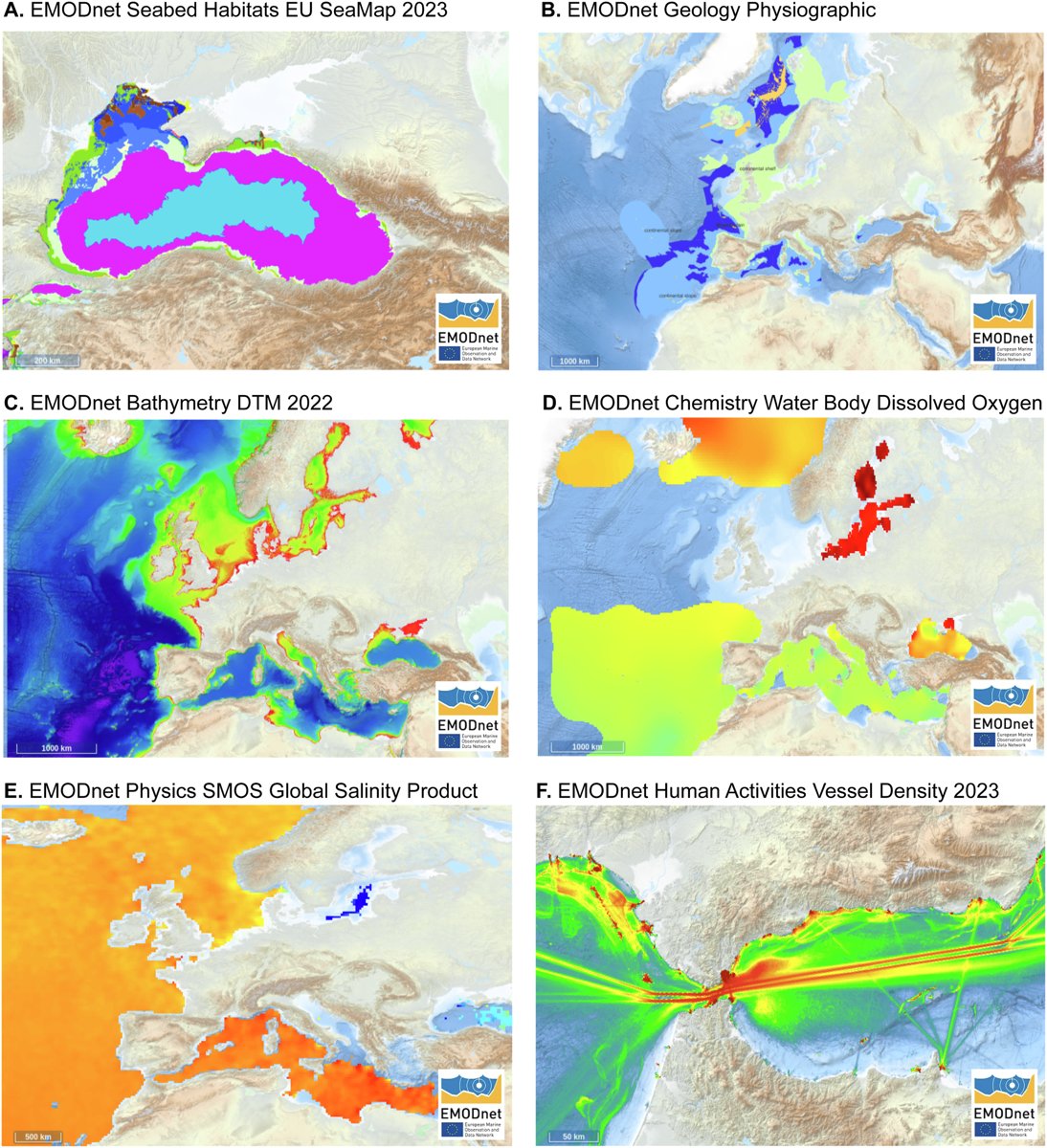
The European Union's free marine data service: measurements and maps of Europe's seas in seven themes, from seabed depth and habitats to species, chemistry and shipping, through one portal.
open dataAPIopen participation
Tags: ocean, Copernicus, what-if scenarios, open platform, Europe