term · draft
Polycrisis and metacrisis
Two words for the world's crises taken together: what each means, who uses them, and the few places they touch the modelling of places.
Readers who come to modelling from writing about the state of the world will meet two words, polycrisis and metacrisis. Both name the many crises of the present taken together. They differ in what they say lies underneath.
Polycrisis comes from Edgar Morin and Anne Brigitte Kern's 1999 book Homeland Earth: "There is no single vital problem, but many vital problems, and it is this complex intersolidarity of problems, antagonisms, crises, uncontrolled processes, and the general crisis of the planet that constitutes the number one vital problem." In current use it means a cluster of global risks whose combined effect exceeds the sum of the parts. The word was taken up at the World Economic Forum in Davos in 2023.1
Metacrisis is the newer term, in use since about 2015 and credited by its proponents to a 2016 paper by Nicholas Hedlund and colleagues. It keeps the many interlocking crises, ecological, technological, political, economic, and adds a claim about their root: a crisis of sensemaking, the breakdown of how people come to know things together, and a crisis of meaning. Jonathan Rowson puts it as needing "to better understand who and what we are, individually and collectively, in order to be able to fundamentally change how we act."1
The metacrisis conversation is mostly philosophical, carried in essays, podcasts and small institutes outside universities. A 2025 white paper from the Institute of Applied Metatheory calls this scene the "liminal web" and lists its schools: Perspectiva, the Consilience Project, Game B, metamodernism, integral theory, critical realism and Nora Bateson's Warm Data, with others. The paper maps these schools by worldview and lineage. It contains no data and no models, and treats technical and engineering responses as one worldview among several.1
Where the two traditions meet:
- A test for a model. The white paper borrows from Roger Walsh what he calls the Single Focus Fallacy: one issue matters most, one cause explains everything, or one fix solves it.1 A model of a place can fail the same way, by reducing a watershed or a city to a single variable.
- Whole-system models already exist. The Club of Rome, which the white paper cites among earlier big-picture thinkers, commissioned The Limits to Growth in 1972, a computer model of population, industry, food, resources and pollution interacting.
- Paradigms as a lever. Donella Meadows, one of its authors, ranked twelve places to intervene in a system. Numbers such as taxes and subsidies come last. Second from the top is "the mindset or paradigm out of which the system arises", and first is the power to transcend paradigms.2 It is the point where a modeller's account of a system and the metacrisis writers' account of worldviews say the same thing. Her book Thinking in Systems ends on the list.
For deciding what kind of problem a place presents before choosing a model, see Cynefin.
- aka
- meta-crisis, poly-crisis
refers to this entry as a source
-
The 1972 Club of Rome report by Meadows, Meadows, Randers and Behrens that used the World3 system-dynamics model to ask whether exponential growth in population and industry could continue on a finite planet.
Donella Meadows's primer on systems thinking, published in 2008 from her draft manuscript, on stocks, flows, feedback and the places where a system can be changed.
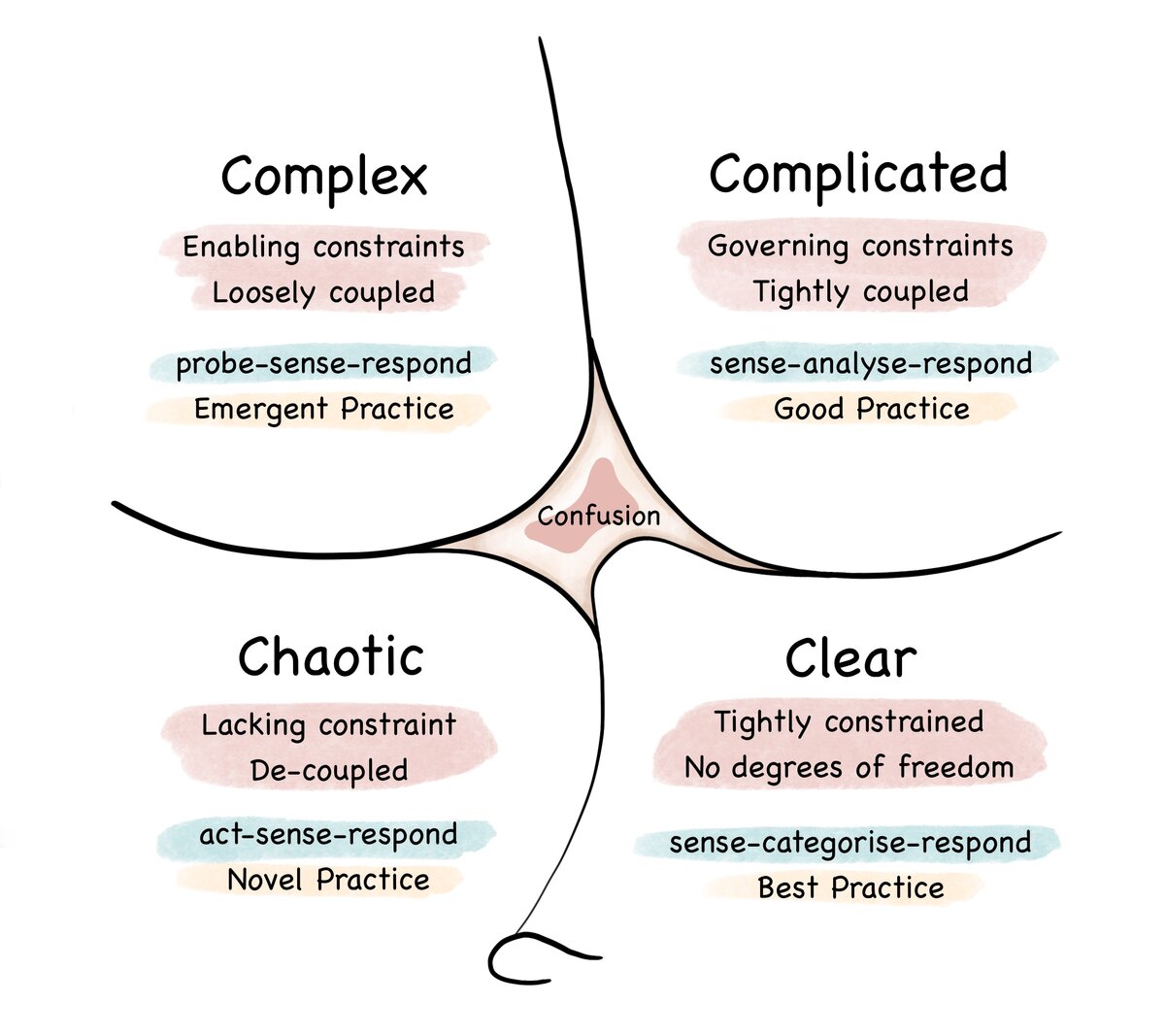
Dave Snowden's framework of five domains (clear, complicated, complex, chaotic and confused), each with its own mode of action and its own limits on prediction.
Tags: polycrisis, metacrisis, vocabulary, systems thinking, worldviews, neighbouring field