term · draft
Ontology
The set of things, kinds and relations a model admits: the decision about how to cut a continuous world into parts that can be named, counted and simulated.
In software an ontology is the inventory of kinds a system knows, the properties each kind carries, and the relations allowed between them. A city data model says that a building has a footprint, a height and a use, and that it stands on a parcel, and a hydrological model says that a catchment drains through reaches to an outlet. Every model of a place has one, whether written down as a standard, implied by a database schema, or buried in the code.
The word is borrowed from philosophy, where it names the study of what exists. The world does not come in pieces. It is one continuous whole, and a "thing" is a region of it where relationships are so tightly entangled that it is useful to draw a boundary and name the inside: a river, say, or a storm. The boundary is a human convenience that more or less holds. John Muir put the other side of it in My First Summer in the Sierra: "When we try to pick out anything by itself, we find it hitched to everything else in the universe."
How people draw those boundaries is the subject of prototype theory. Eleanor Rosch's work from 1971 showed that membership in a category is graded, with some members more central than others: a robin is a better example of a bird than a penguin. Categories form around a best example rather than a list of necessary features. George Lakoff's Women, Fire, and Dangerous Things (1987) built on this, and in his account categories are radial, structured around central cases with extensions. Their boundaries are fuzzy, and they are shaped by idealised cognitive models that can differ between cultures. The book's title comes from a noun class in the Dyirbal language that groups women, water, fire, violence and certain animals.
A model's ontology is a bet about which boundaries matter for the question being asked, so two models of the same place drawn with different boundaries will not join without translation. Standards such as CityGML, encoded as CityJSON, are shared bets that let one city's data be read by another's tools. At planetary scale, Donges and colleagues' taxonomies for World–Earth models propose three kinds of subsystem and a scheme for the interactions between them, with the aim of combining components from different modelling traditions and naming the missing feedback loops. The parts of a digital twin shows how the ontology relates to the other parts. The review of Jessica Talisman's book Ontology Pipeline covers the steps of building one, starting with an agreed vocabulary and ending with a knowledge graph.
- aka
- data model, taxonomy, schema, vocabulary
refers to this entry as a source
-
A 2021 Earth System Dynamics paper by Donges and colleagues proposing three taxa of modelled subsystems (biophysical, socio-cultural, socio-metabolic) and a scheme for classifying their interactions.
open source
-
A JSON encoding of the OGC CityGML data model for 3D city models, with open tools to convert, validate, view and edit files; version 2.0 is an official OGC standard.
open sourceopen participation
cited by
-
A running model of a place is four things that are built, bought and broken separately: data, an ontology, an engine, and a presentation.
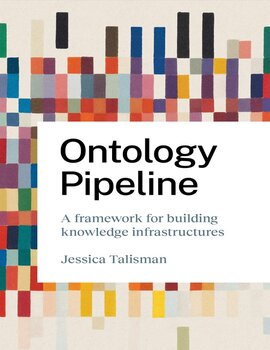
Jessica Talisman's 2026 book from Technics Publications, setting out a six-stage method for building a knowledge system from controlled vocabulary to knowledge graph, with a browser Studio and a SKOS editor.
Tags: ontology, categories, data model, knowledge