article · draft
The parts of a digital twin
A running model of a place is four things that are built, bought and broken separately: data, an ontology, an engine, and a presentation.
The shelves of the Technologies area follow these four layers in order.
Data. What was measured or recorded: satellite and aerial imagery, weather stations, river gauges, surveys, sensor feeds, census tables, land records, historical decisions. The Data shelf lists sources a model can be fed with, and on what terms.
Ontologies. The step from data to knowledge. An ontology decides what the things are, which properties they carry, and how they relate. A building has a height and a use, a catchment drains through reaches, and an agent follows a rule. Every engine has an ontology, usually unstated, and joining two models is mostly the work of reconciling two ontologies. The Ontologies shelf holds the standards, papers and tools for this layer. The term entry Ontology says why the world has to be cut up at all, and a review of The Ontology Pipeline describes building one step by step.
Engines. The simulations that move state forward in time: snow cover deepening, a fire crossing a forested ridge, traffic reassigning itself after a closure, a housing market responding to a zoning change. The Engines shelf is the largest, arranged by the task a person is trying to do.
Presentation. How a person sees what the model did: a globe, a map, a chart, a story, a before-and-after. Nothing is simulated in this layer, but it is where most people meet a model, and where a result becomes an argument or fails to. The Presentation shelf holds the libraries and viewers.
Different people make each layer. A city buys its data from one set of suppliers and adopts a data model from a standards body. It runs engines written by research groups or vendors, and shows the result in a viewer written by someone else again. Each layer can be open or closed on its own, so entries on this site have an open block with separate fields for source, data, API and participation.
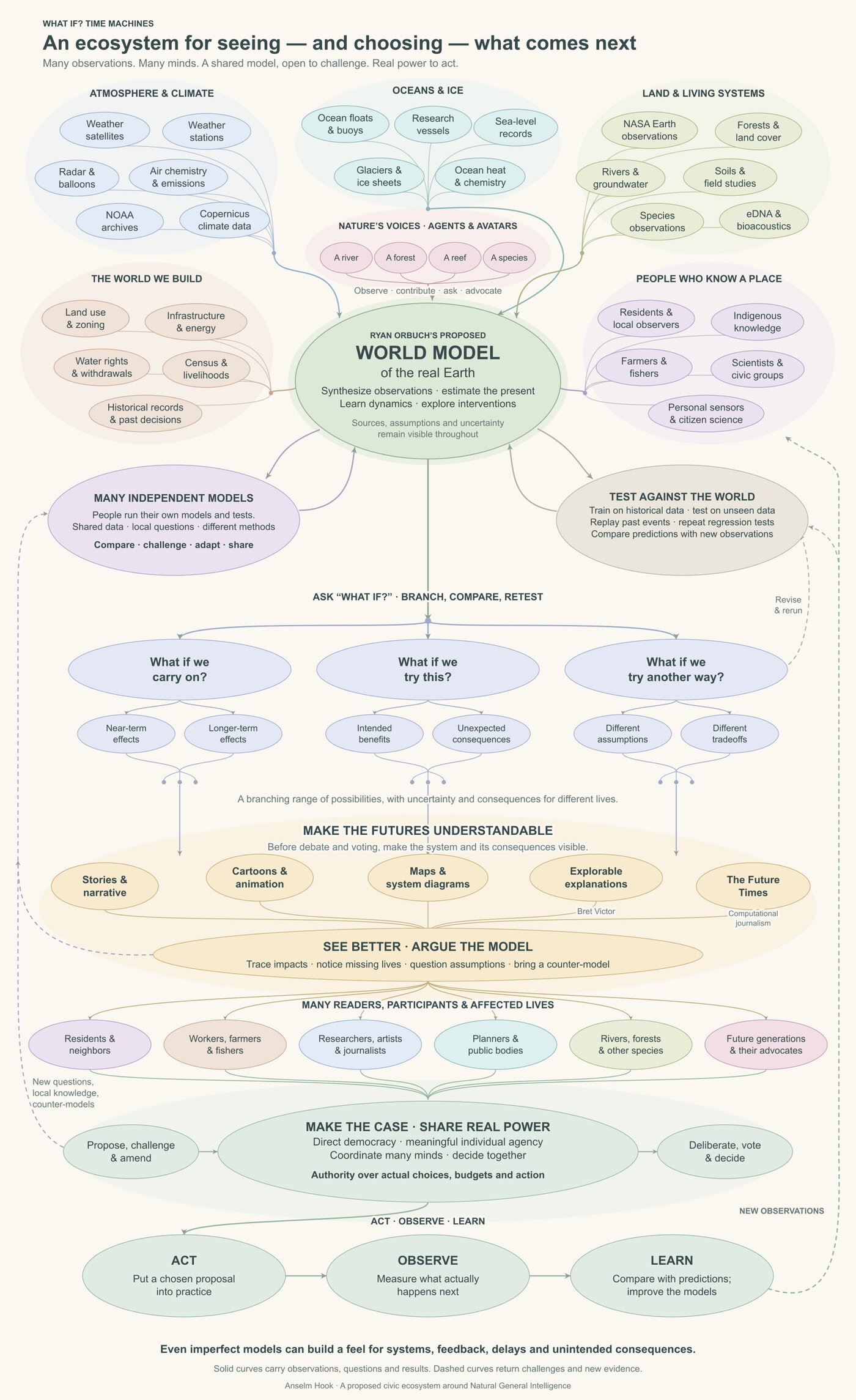
The same stack at planetary scale, drawn by Anselm Hook for What If? Time Machines (September 2026).1 The engine at the centre is one specific proposal, Ryan Orbuch's world model of the real Earth.1 The shape around it is general to any twin of a place in use: observations above, many independent models beside, presentation and people below, and a loop back from what happened.
The picture adds a loop to the four layers: a twin that is used changes the place it models. The place sends back new observations, and the model is checked against them and revised. The guide Check it against what happened covers this loop. The Notable twins have each survived a few turns of the loop.
- tier
- 2
is about this entity
-
A computational representation of a real object, place or system, linked to information about its real-world counterpart.
refers to this entry as a source
-
The set of things, kinds and relations a model admits: the decision about how to cut a continuous world into parts that can be named, counted and simulated.
Tags: stack, architecture, overview, ontology, presentation