mandate · draft
Kunming-Montreal Global Biodiversity Framework
The global biodiversity agreement adopted under the Convention on Biological Diversity in December 2022: four goals for 2050, twenty-three targets for 2030, and a commitment by each Party to set national targets.
The Parties adopted the framework at their fifteenth meeting, COP 15, after four years of consultation and negotiation. It follows the Convention's earlier strategic plans and is built around the Convention's vision for 2050, a world living in harmony with nature. The four goals cover protecting and restoring ecosystems and species, using nature sustainably, sharing the benefits of genetic resources fairly, and securing money and capacity. The framework puts the biodiversity finance gap at 700 billion dollars a year.
The targets fall into three groups. Some reduce threats to biodiversity. Some meet people's needs through sustainable use and fair benefit-sharing. The rest are tools and solutions for implementation. Several of the targets concern places and would send someone to a map or a model. Target 1 asks that all areas be under biodiversity-inclusive spatial planning or effective management, so that by 2030 almost no more areas of high value for biodiversity are lost. Target 2 asks that at least 30 per cent of degraded land, inland water and marine ecosystems be under restoration. FAO tracks it through its Framework for Ecosystem Restoration Monitoring, and the 2026 report Nature's comeback took stock of it at the Decade's midpoint. Target 3, the 30 by 30 target for protected and conserved areas, has its own entry at 30 by 30. Target 12 asks for more and better connected green and blue space in cities. Target 14 asks that biodiversity be built into planning, environmental assessment and, where appropriate, national accounting. Target 21 asks that the best available data and knowledge be accessible to decision makers and the public.
Every Party committed to set national targets, and other actors were invited to make their own commitments. COP 15 also adopted a monitoring framework with indicators for each target, a mechanism for planning, monitoring, reporting and review, and decisions on finance and capacity. For each target the Secretariat publishes a guidance note listing the adopted indicators and resources for setting national targets. The Secretariat calls these notes a work in progress. The official text is decision 15/4. At its next meeting the Conference of the Parties was to take stock of the national targets and commitments.
Most of the mapping and modelling these targets call for begins with land use change.
- issued by
- Conference of the Parties to the Convention on Biological Diversity, at its fifteenth meeting (COP 15)
- binds
- the Parties to the Convention, each of which committed to set national targets to implement it
- by
- 2030 for the targets, 2050 for the goals
- adopted
- 2022-12
- homepage
- https://www.cbd.int/gbf
progress against it is counted with this data
-
FAO's free registry of ecosystem restoration initiatives, with their mapped areas, activities and indicators; the official monitor of the UN Decade on Ecosystem Restoration.
partly open datapartly open participation
discussed in
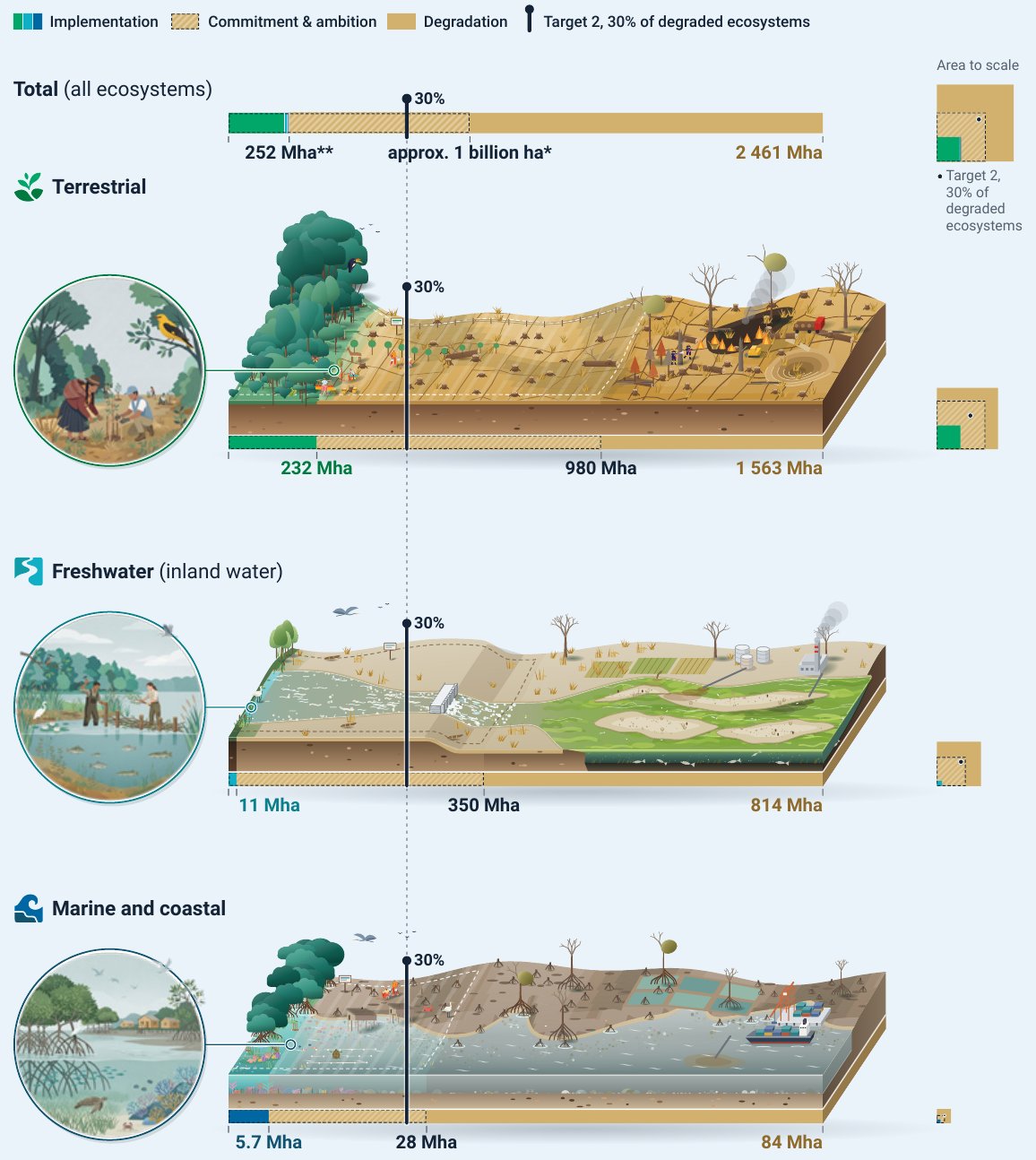
FAO, UNEP and the CBD Secretariat's 2026 count of restoration worldwide: 252 million hectares in 149 countries, mostly on land, against the commitments, the 30 per cent target and the money needed.
Tags: biodiversity, conservation, global targets, 2030, 2050, convention on biological diversity