book· draft
Cities and Complexity
Michael Batty's 2005 account of modelling cities with cellular automata, agent-based models and fractals, the bottom-up methods under much of today's urban simulation.
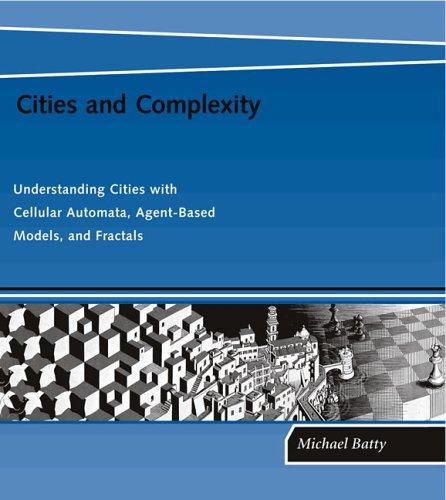
Batty sets urban dynamics inside complexity theory and shows, with worked models, how many simple interacting processes add up to the organised whole of a city. He argues that planning has been moving from top-down control to bottom-up explanation, that bottom-up processes have outcomes that cannot be predicted in detail, and that fractal geometry and nonlinear dynamics are the tools suited to them. The early chapters build cities from cellular automata, where change comes from the local rules of simple cells; later ones move to agents and to the fractal structure of urban form. The paperback appeared in 2007.
For a builder it is the textbook on the family of methods, cellular automata, agent-based models, fractal growth, that most place-scale simulations draw on, with the reasoning for why those methods fit cities and what they cannot be expected to deliver.
Cover via Open Library.
- authors
- Michael Batty
- publisher
- MIT Press
- year
- 2005
- isbn
- 9780262025836
- url
- https://openlibrary.org/works/OL5040453W
Tags: cities, cellular automata, agent-based, fractals, simulation